Remote Work in Slovakia

There is no single model of remote work in Slovakia. Its prevalence varies considerably by industry, organisation size and location, with hybrid arrangements combining remote and on-site work being the most common.
Remote work opportunities depend strongly on industry
and the nature of the work
In Slovakia, opportunities for remote work vary considerably across industries. All organisations in the Information and Communication sector included in the survey reported having tasks that can be performed remotely and offering remote work to at least some extent. In Professional, Scientific and Technical Activities, the corresponding share is 80%.
In Manufacturing, around 40% of organisations offer remote work. A further 45% report having tasks that could be carried out remotely, but do not make this option available to employees. Only 14% of respondents in Manufacturing indicate that remote work is not feasible given the nature of the tasks performed. A similar pattern can be seen across the remaining industries: 41% of organisations offer remote work, while the same share do not, despite having tasks that could be performed remotely.
Overall, 46% of organisations in the survey offer remote work, while a further 39% have tasks that could be performed remotely but do not make remote work available to employees. Differences across industries largely reflect the nature of the jobs involved: remote work is more common in knowledge-intensive services, whereas a substantial share of jobs in manufacturing still requires employees to be physically present on-site.
Note: Statistics for K-Financial & Insurance activities are not published because the sample size is too small to ensure data confidentiality.
Larger organisations are more likely to offer remote work
In Slovakia, remote work is more common in larger organisations. It is offered by 64% of large organisations, 57% of medium-sized organisations and 44% of small organisations. Remote work also varies considerably by organisation size. Almost 40% of small organisations report having tasks that could be performed remotely but do not offer this option to employees. The corresponding share is 32% among medium-sized organisations and 29% among large organisations. The share of organisations reporting that remote work is not feasible given the nature of the tasks performed is lower across all three size groups, ranging from 7% among large organisations to 16% among small organisations.
Remote work is far more common in urban areas
In Slovakia, remote work is most widespread among organisations located in urban areas. It is offered by 73% of organisations in urban locations, compared with 32% in suburban areas and 30% in rural areas.
There are also clear differences in how fully the potential for remote work is used. In rural areas, 54% of organisations report having tasks that could be performed remotely but do not make this option available to employees. The corresponding share is 45% in suburban areas, while in urban locations it is considerably lower, at around 20%.
Overall, the results show clear differences between urban, suburban and rural locations: organisations in urban areas are much more likely to make use of existing opportunities for remote work, while this potential remains largely untapped in many suburban and rural organisations.
Nearly one in three organisations offer remote work 1–2 days a week
Among all organisations participating in the survey in Slovakia, around 31% allow at least some employees to work remotely 1–2 days per week. Remote work for 3–4 days per week is offered by 14% of organisations, while around 11% allow employees to work remotely 5 days or more per week.
Across the full sample in Slovakia, 1–2 remote days per week is therefore the most common arrangement. More intensive forms of remote work, where employees spend most of the working week away from the workplace, are considerably less widespread.
Remote work usage shows only minor gender differences
Looking across all organisations participating in the survey in Slovakia, there are no substantial differences in remote work usage between women and men. In around 69% of organisations, none of the female employees work remotely at least one day per week. For male employees, the corresponding share is 72%.
Gender differences remain small across the other categories as well. Around 9% of organisations report that more than two-thirds of their female employees work remotely, compared with approximately 6% for male employees. In the category where 33–66% of employees work remotely, the share is slightly higher for men (6%) than for women (4%).
Among organisations participating in the survey in Slovakia that offer remote work, it is most common for only a minority of employees to work remotely. In around 40% of organisations, between 1% and 33% of female employees work remotely, compared with 36% of organisations reporting the same share for male employees.
A somewhat larger gender difference appears in organisations where remote work is more widespread. In 20% of organisations, more than two-thirds of female employees work remotely at least one day per week, compared with 13% for male employees. Overall, the results for Slovakia show no major gender differences, although women are more strongly represented in the highest remote-work category.
Key highlights
- Organisations with a formal remote work policy have, on average, a 65% higher share of employees working remotely.
- Nine out of ten employers do not contribute to the costs associated with working from home, such as energy, furniture or internet. Support is mainly limited to basic work equipment, such as monitors, keyboards and other computer accessories.
- Among the most frequently reported disadvantages of remote work are more difficult team coordination and the difficulty of monitoring employees.
From an employer perspective, remote work also plays an important role in employee retention.
- 70% of organisations that offer remote work see it as a tool for retaining employees.
- In the context of labour shortages, remote work is one of the key measures used by employers, alongside flexible working hours and pay adjustments. At the same time, the results point to clear areas for improvement:
- 62% of organisations offer no activities aimed at supporting employees’ mental health and well-being.
- 78% did not provide any training or development programmes during the previous year.
Remote work has become an established feature of the labour market. Its benefits are particularly evident in employee satisfaction and retention, but making remote work effective requires systematic management support – from setting clear rules for coordination to investing in employee development and well-being.
Profile of organisations participating in the survey
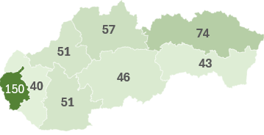
In terms of organisation size, the largest groups were those with:
- 25–49 employees
- 50–99 employees
- 10–19 employees

✓ 8% of respondents employ agency workers under temporary employment arrangements.
✓ 15% of respondents employ at least one cross-border worker, defined for the purposes of the survey as an employee who does not live in Slovakia.
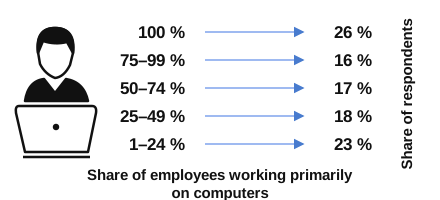
Based on data from 512 organisations, opportunities for remote work in Slovakia vary considerably and depend strongly on the industry and the nature of the work performed. Across all respondents, the average share of employees whose tasks can be performed remotely at least to some extent is approximately 31%. The results differ substantially across industries.
Industries with limited potential for remote work:

C Manufacturing – most manufacturing organisations in the survey report low levels of remote work, as a substantial share of their workforce needs to be physically present at the workplace.

F Construction – remote work in this industry is largely limited to roles such as architects, civil engineers and administrative staff.

H Transportation and Storage – opportunities for remote work are very limited, as most employees are tied to operational sites, warehouses or transport activities.
Industries with high potential for remote work:

J Information and Communication – organisations in this sector report that between 50% and 100% of employees can work remotely. By organisation size, fully remote work is most commonly available in smaller organisations.

M Professional, Scientific and Technical Activities – activities such as accounting, legal services, consulting, design and research are highly digitalised, making remote work considerably more feasible than in sectors such as manufacturing.